
Short Answer
Overview
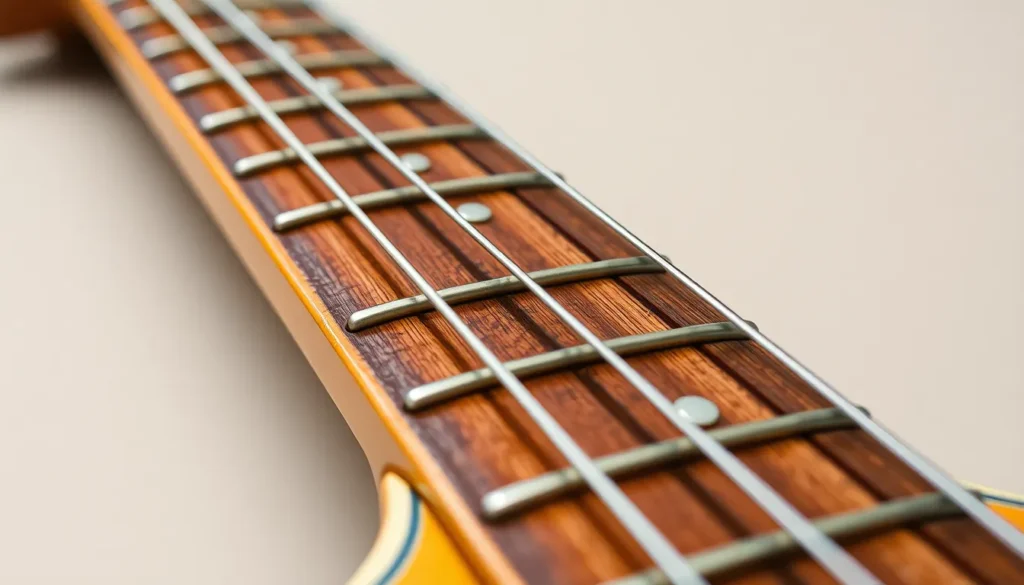
A fret on a guitar is a thin strip of material—typically metal—embedded along the neck’s fingerboard. Frets divide the fingerboard into fixed segments at intervals related to a musical scale, allowing the player to produce specific pitches by pressing the strings down behind these strips. This structural feature is fundamental to the guitar’s design and function, enabling accurate pitch control and facilitating the playing of melodies, chords, and scales.
Detailed Explanation
Frets are usually made from nickel-silver alloy or stainless steel and are installed perpendicular to the strings, extending slightly above the fingerboard’s surface. Each fret represents a semitone increment in the chromatic scale, which means moving from one fret to the next raises the note by one half step. The placement of frets follows a mathematical pattern based on the equal temperament tuning system, which divides an octave into twelve equal parts. This precise spacing is critical for maintaining intonation and ensuring that notes sound in tune across the fretboard.
How It Works
When a guitarist presses a string down behind a fret, the string’s vibrating length is effectively shortened to the distance between the fret and the bridge of the guitar. This shortening raises the pitch of the note produced. The fret acts as a hard contact point, enabling consistent sound production and reducing the effort needed to stop the string compared to fretless instruments. The combination of fret placement and string tension determines the exact pitch sounded.
Examples
- On a standard guitar, the first fret is closest to the headstock and produces the note one semitone higher than the open string.
- The twelfth fret is typically marked distinctively because it represents the octave, doubling the frequency of the open string.
- Fretless guitars exist but are less common; these rely on finger placement for pitch control without the fixed segments that frets provide.
Pros and Cons
- Pros: Frets enable precise pitch control, facilitate faster playing, and help beginners learn finger positioning.
- Cons: Frets limit microtonal flexibility compared to fretless instruments and can wear over time, requiring maintenance or replacement.
Comparison Table
| Aspect | Fret | Fretless Fingerboard |
|---|---|---|
| Meaning | Raised metal strip dividing the fingerboard into semitone intervals | Smooth fingerboard without raised markers, pitch controlled solely by finger placement |
| Pitch Accuracy | High, due to fixed semitone segmentation | Variable, dependent on player skill |
| Ease of Play | Easier, as frets provide tactile guidance and consistent contact points | Harder, requires precise finger placement |
| Musical Flexibility | Limited microtonal capability | Greater microtonal and glissando possibilities |
Decision Checklist
- Use this if you want consistent pitch and easier finger positioning on a guitar.
- Avoid this if you require microtonal expression or a fretless playing style.
- Check this first when choosing a guitar type or considering modifications to the fingerboard.
What is the easiest way to understand a fret on a guitar?
Visualize a fret as a marker that shortens the vibrating length of a guitar string to produce specific notes. Pressing the string down just behind a fret changes its pitch according to the fret’s position, enabling the player to navigate the musical scale accurately and efficiently.
FAQ
What is the purpose of frets on a guitar?
Frets divide the guitar neck into fixed intervals, allowing the player to produce precise pitches by shortening the vibrating length of the strings when pressed.
How are frets spaced on a guitar?
Frets are spaced according to the equal temperament system, where each fret represents a semitone, and the distance between frets decreases as you move up the neck.
Can a guitar be played without frets?
Yes, fretless guitars exist and allow for continuous pitch variation, but they require greater finger precision and skill to play in tune.






Leave a Reply