
Short Answer
Overview
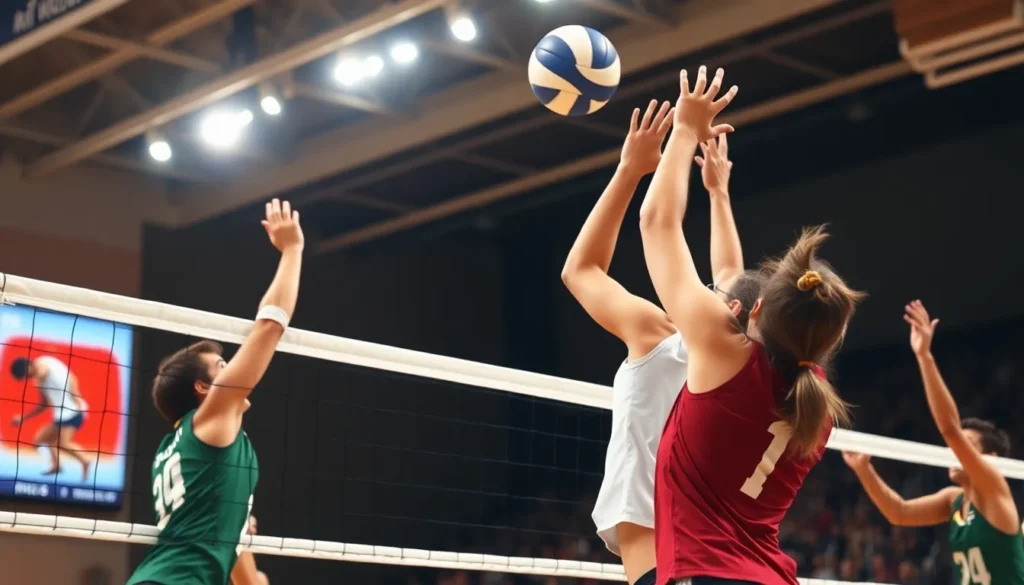
In volleyball, a kill is an offensive play where a player delivers an attack hit that results directly in a point for their team. It occurs when the ball is spiked or hit in such a way that the opposing team cannot return it successfully. The term is commonly used to describe a successful spike or attack hit that ends the rally immediately.
Detailed Explanation
A kill is recorded when an attacker spikes the ball and it either lands in the opponent’s court untouched or is touched but not kept in play by the opposing team, causing a point. It is an important statistic in volleyball that measures the effectiveness and efficiency of offensive players, especially hitters or spikers. Kills reflect a player’s ability to convert offensive opportunities into points.
Kills can be executed in different ways, including powerful spikes, tip shots, or off-speed hits. The key factor is that the hit results in an immediate point without any further play.
How It Works
During a volleyball rally, the attacking team attempts to score by sending the ball over the net into the opponent’s court. When an attacker performs a spike or an attack hit aiming to finish the play, a kill occurs if:
- The ball lands on the opponent’s court without being touched.
- The ball is touched by an opponent but is not returned into play.
- The opponent’s attempt to dig or pass the ball fails to keep it in play.
Only the first attack hit that results in a point is counted as a kill. If the ball is deflected but eventually kept in play and the rally continues, a kill is not recorded at that point.
Examples
- Powerful Spike: A player jumps near the net and forcefully spikes the ball into an open spot on the opponent’s court, scoring directly.
- Tip Shot: Instead of a full spike, a player lightly tips the ball over blockers and into the opponent’s court, catching them off guard and scoring.
- Block Deflection: An attacker hits the ball into the opponent’s block, and the ball deflects off the blockers’ hands and lands untouched on the opponent’s side.
Why It Matters
Kills are a critical metric used by coaches, players, and analysts to evaluate offensive performance in volleyball. A high number of kills indicates a player’s ability to successfully convert sets into points, contributing significantly to their team’s success. Tracking kills helps in assessing both individual and team offensive efficiency.
Common Misconceptions
Misconception: A kill only counts when the ball is spiked hard.
Correction: A kill can be any attack hit that results in a point, including controlled tips or off-speed hits, not just powerful spikes.
Misconception: Every time a player attacks, it results in a kill.
Correction: A kill is only recorded when the attack results directly in a point; if the ball is kept in play by the opponent, it is not a kill.
Pros and Cons
Pros:
- Measures offensive effectiveness clearly.
- Helps identify key attacking players.
- Useful for tactical analysis and coaching.
Cons:
- Does not account for the difficulty of the attack or defensive context.
- May overlook contributions of players in non-scoring roles.
- Can oversimplify overall performance by focusing only on scoring hits.
Comparison Table
| Aspect | Kill in Volleyball | Attack Attempt |
|---|---|---|
| Meaning | An attack hit that results directly in a point. | Any attempt to hit the ball offensively, regardless of outcome. |
| Outcome | Immediate point scored. | Can result in a point, continuation of play, or error. |
| Statistical Use | Tracked as a positive scoring metric. | Tracked to evaluate volume of offensive attempts. |
Decision Checklist
What is the easiest way to understand a Kill in Volleyball?
The simplest way to understand a kill is to think of it as a successful spike or attack where the ball lands in the opponent’s court without being returned, immediately scoring a point for the attacking team.
FAQ
What counts as a kill in volleyball?
A kill counts when an attack hit results directly in a point, either because the ball lands untouched on the opponent’s court or is touched but not returned into play.
Is every spike a kill?
No. Not every spike counts as a kill; the ball must result in an immediate point for it to be considered a kill.
Who typically gets the most kills on a volleyball team?
Outside hitters and opposite hitters usually record the most kills because they are primary offensive players who frequently attack the ball.




Leave a Reply