
Short Answer
Overview
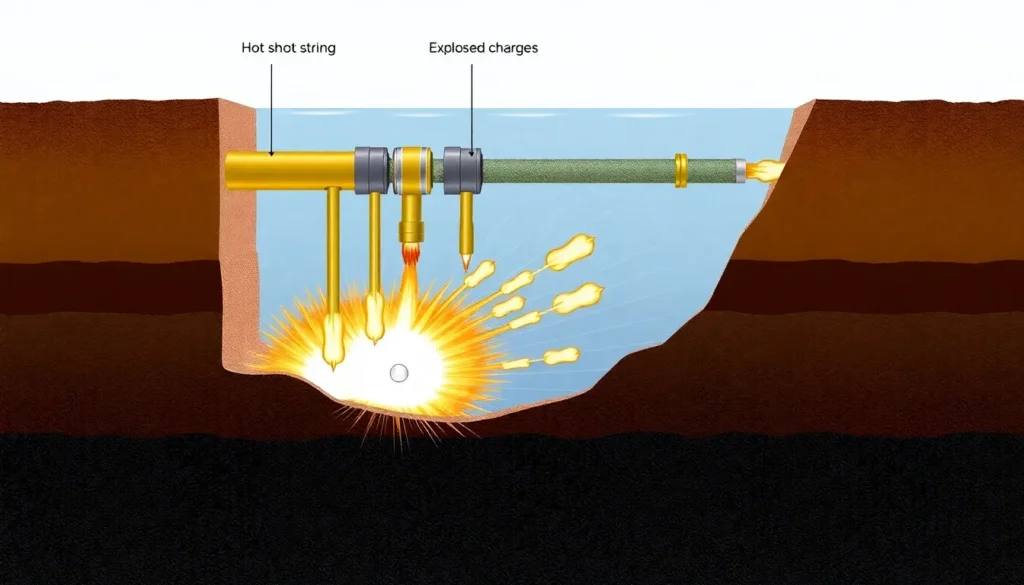
A shot string is a tool used in the oil and gas industry primarily during well completion operations. It consists of a series of explosive charges connected by detonating cord, arranged to perforate the casing and surrounding rock formation of a wellbore. This process allows hydrocarbons such as oil or natural gas to flow into the well and be extracted. Shot strings play a crucial role in enhancing productivity by creating precise, controlled pathways through solid geological formations.
Detailed Explanation
Typically, a shot string includes multiple shaped charges aligned along a carrier or wireline. Each shaped charge is designed to focus an explosive force into a concentrated jet capable of penetrating steel casing, cement layers, and into the reservoir rock. The charges are linked by detonating cord that transmits the explosive signal sequentially or simultaneously, depending on the design and operational requirements.
The construction and arrangement of a shot string are carefully engineered to ensure consistent penetration depth and angle, which are critical for optimizing reservoir connectivity and minimizing damage to the surrounding formation. The number of charges and their spacing vary based on well design, formation characteristics, and production goals.
How It Works
During well completion, the shot string is lowered into the wellbore to the target depth. Once positioned, the detonating cord is initiated from the surface or downhole, causing the shaped charges to explode in sequence or simultaneously. Each explosion perforates the casing and adjacent formation, creating tunnels or perforations that facilitate fluid flow.
The shaped charge’s design focuses the energy into a narrow jet of high-velocity gas and molten metal, which cuts through tough materials. The resulting perforations provide a path for hydrocarbons to enter the wellbore while minimizing formation damage. The timing and arrangement of the charges ensure that the perforations are strategically placed to maximize extraction efficiency.
Examples
- Single Shot String: A basic configuration with a few charges used in shallow or small-diameter wells.
- Multi-Stage Shot String: Employs multiple sets of charges separated by delay detonators to create perforations at different depths or zones within the well for staged fracturing.
- Wireline-Delivered Shot String: The shot string is attached to a wireline and lowered into the well, allowing precise placement and retrieval.
Pros and Cons
- Pros: Enables controlled and targeted perforation, improves hydrocarbon flow, adaptable to various well types, and enhances overall well productivity.
- Cons: Risk of formation damage if improperly designed, potential safety hazards during handling and detonation, and cost considerations depending on the complexity of the shot string.
Comparison Table
| Aspect | Shot String | Alternative/Related Topic |
|---|---|---|
| Meaning | A series of explosive charges arranged to perforate well casing and formation. | Hydraulic Fracturing: A process using pressurized fluid to fracture rock formations. |
| Function | Create perforations for fluid flow in wells. | Increase permeability by fracturing the reservoir rock. |
| Delivery Method | Typically wireline or tubing conveyed. | Surface injection of fracturing fluids. |
| Use Case | Well completion and stimulation. | Enhanced oil recovery and reservoir stimulation. |
Decision Checklist
- Use this if: Precise, controlled perforation of the casing and formation is required.
- Avoid this if: The formation is highly sensitive to damage or alternative stimulation methods are preferable.
- Check this first: Well parameters, formation properties, and safety protocols before deployment.
What is the easiest way to understand a Shot String?
The easiest way to understand a shot string is to think of it as a line of small, precisely placed explosives connected together, designed to make holes in a well’s metal and rock layers so oil or gas can flow freely into the wellbore. It’s like a carefully controlled demolition inside the well to create pathways for extraction.
FAQ
What is the main purpose of a shot string?
The main purpose of a shot string is to perforate the well casing and surrounding rock formation to create flow channels that allow oil or gas to enter the wellbore for production.
How is a shot string deployed in a well?
A shot string is typically lowered into the wellbore using a wireline or tubing. Once positioned at the desired depth, the detonating cord is initiated to activate the shaped charges.
What safety measures are important when handling shot strings?
Handling shot strings requires strict adherence to safety protocols including proper storage, transportation, and controlled detonation procedures to minimize the risk of accidental explosions and injuries.


Leave a Reply