
Short Answer
Overview
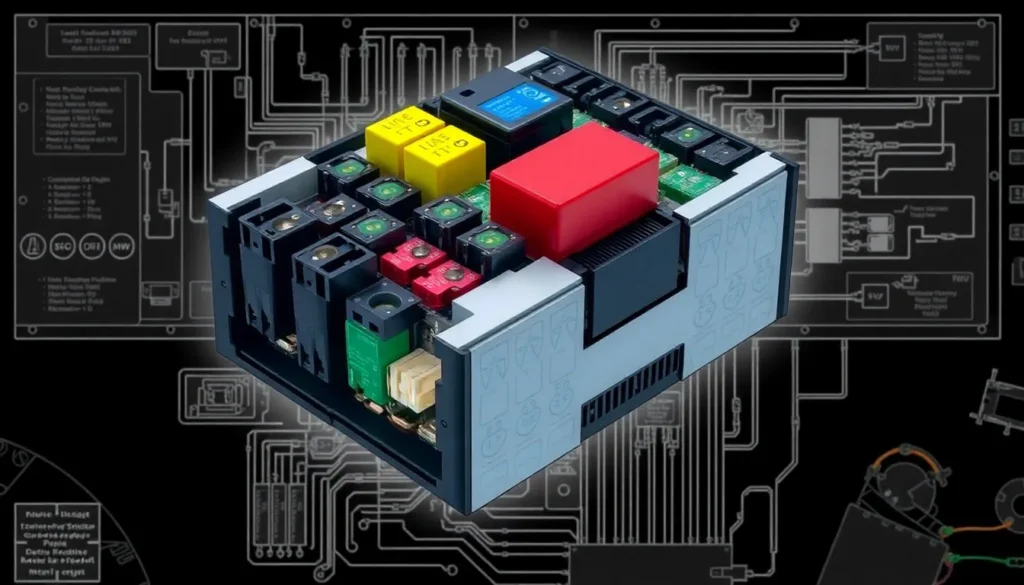
An Integrated Power Module (IPM) is a compact electronic device that consolidates multiple power management components and functions into a single module. It is primarily utilized in automotive and industrial environments to control, distribute, and protect electrical power systems. The IPM typically integrates fuses, relays, circuit breakers, and control electronics to optimize power distribution and system reliability.
Detailed Explanation
The Integrated Power Module serves as a centralized hub for managing electrical circuits within a vehicle or machinery. By combining elements such as fuses, relays, and control units, the IPM reduces wiring complexity and improves system diagnostics and maintenance. It is engineered to handle high current loads safely and efficiently, often incorporating microcontrollers or electronic control units (ECUs) to monitor and regulate power flow based on system demands.
How It Works
The IPM functions by receiving electrical input from the power source—usually a battery or alternator in vehicles—and distributing it to various subsystems such as lighting, ignition, and infotainment. Internal relays within the module switch power circuits on or off under the command of control electronics. Integrated fuses protect the circuits from overcurrent conditions, while additional sensors and controllers may monitor voltage, temperature, and current to prevent damage and optimize performance.
Examples
- Automotive IPM: Modern cars often use IPMs to manage power distribution to components like headlights, fuel pumps, and electronic control units.
- Industrial Machinery IPM: In industrial settings, IPMs control motors, sensors, and actuators, ensuring efficient and safe operation of equipment.
- Hybrid and Electric Vehicles: IPMs in these vehicles manage complex power flows between batteries, electric motors, and auxiliary systems.
Why It Matters
The Integrated Power Module enhances system reliability by centralizing power management, reducing wiring complexity, and improving fault detection. This integration supports better space utilization, reduces manufacturing costs, and simplifies maintenance. In automotive applications, IPMs contribute to vehicle safety and energy efficiency, which are critical for modern transportation systems.
Common Misconceptions
Misconception: An IPM is just a fuse box.
Correction: While an IPM includes fuses, it also incorporates relays, control electronics, and diagnostic functions beyond simple overcurrent protection.
Misconception: IPMs are only used in cars.
Correction: Although prevalent in automotive applications, IPMs are also widely used in industrial machinery and electric vehicles.
Pros and Cons
Comparison Table
| Aspect | Integrated Power Module | Traditional Fuse and Relay Box |
|---|---|---|
| Meaning | Combines fuses, relays, and control electronics in a single unit | Separate fuses and relays arranged in a box without integrated control electronics |
| Functionality | Advanced power management with diagnostics and control | Basic circuit protection and manual relay control |
| Complexity | Higher integration and complexity | Lower complexity with discrete components |
| Space Efficiency | More compact design | Requires more space due to separate components |
| Maintenance | Requires specialized knowledge for repairs | Simpler to replace individual components |
Decision Checklist
- Use this if: You need centralized power management with enhanced diagnostics and control, especially in modern automotive or industrial systems.
- Avoid this if: Your application requires simple, low-cost circuit protection without the need for integrated control or diagnostics.
- Check this first: Compatibility with your system’s electrical architecture and availability of technical support for integrated electronics.
What is the easiest way to understand an Integrated Power Module?
The easiest way to understand an IPM is to think of it as a combination of a fuse box, relay panel, and control unit merged into one compact device that manages and protects electrical circuits efficiently and intelligently.
FAQ
What is the main purpose of an Integrated Power Module?
The main purpose of an IPM is to centralize the management, protection, and control of electrical power distribution within a vehicle or industrial system.
How does an IPM differ from a traditional fuse box?
An IPM integrates fuses, relays, and control electronics into one module, allowing for advanced diagnostics and control, unlike a traditional fuse box which typically contains only fuses and sometimes relays without integrated control.
Can an Integrated Power Module be repaired if it fails?
Repairing an IPM can be complex due to the integrated electronics; often, the entire module is replaced rather than repaired, although this depends on the specific design and manufacturer guidelines.


Leave a Reply