
Short Answer
Overview
The term “4 out of 6” is a fractional representation indicating that four units are considered from a total of six units. This expression is commonly used in mathematics, assessments, statistics, and various real-world contexts where parts of a whole need to be described. It conveys a ratio, proportion, or fraction that can be interpreted in different ways depending on the context.
Detailed Explanation
A “4 out of 6” can be mathematically expressed as the fraction 4/6. This fraction represents a quantity that is four parts of a total possible six parts. In simplest terms, 4/6 can be reduced to 2/3 by dividing both numerator and denominator by their greatest common divisor, which is 2. This simplification aids in understanding the proportion more clearly.
Additionally, “4 out of 6” can be expressed as a decimal (approximately 0.6667) or a percentage (approximately 66.67%). These different representations are useful in various fields depending on the required format or precision.
How It Works
When using “4 out of 6,” the first number (4) represents the portion or subset under consideration, while the second number (6) represents the total or whole set. This concept is foundational in fractions, ratios, and percentages.
For example, in grading systems, if a student answers 4 questions correctly out of 6, their score can be represented as 4 out of 6. To interpret this score, one can convert it into a percentage by dividing 4 by 6 and multiplying by 100, resulting in approximately 66.67%.
Similarly, in probability or statistics, “4 out of 6” can describe the likelihood of an event occurring 4 times in 6 trials, or the proportion of items with a certain attribute within a sample of six.
Examples
- Education: A student completes 4 correct answers out of 6 total questions on a quiz, resulting in a grade representing 4 out of 6.
- Probability: Rolling a die six times and getting a specific number 4 times can be described as 4 out of 6 occurrences.
- Cooking: A recipe requires 6 cups of flour, but only 4 cups are available, representing 4 out of 6 cups needed.
Pros and Cons
- Pros:
- Simple and straightforward representation of parts to whole.
- Can be easily converted to decimals and percentages for various applications.
- Widely understood and used in many disciplines.
- Cons:
- Without context, the significance of “4 out of 6” may be unclear.
- May require simplification or conversion for easier interpretation.
- In some cases, the fraction does not provide detailed information about distribution or variability.
Comparison Table
| Aspect | 4 Out Of 6 | Alternative/Related Topic (e.g., 2 Out Of 3) |
|---|---|---|
| Meaning | Represents four parts of six total parts (fraction 4/6, simplified 2/3) | Represents two parts of three total parts (fraction 2/3) |
| Decimal Equivalent | Approximately 0.6667 | Exactly 0.6667 |
| Percentage | Approximately 66.67% | Exactly 66.67% |
| Use Cases | General ratios, grading, probability | Equivalent ratios, simplified fractions |
Decision Checklist
- Use this if: You need to express a proportion where the numerator is 4 and the denominator is 6 or the equivalent ratio.
- Avoid this if: You require a simplified fraction or percentage format for clearer communication.
- Check this first: Whether the context demands fraction, decimal, or percentage representation for accurate interpretation.
What is the easiest way to understand 4 Out Of 6?
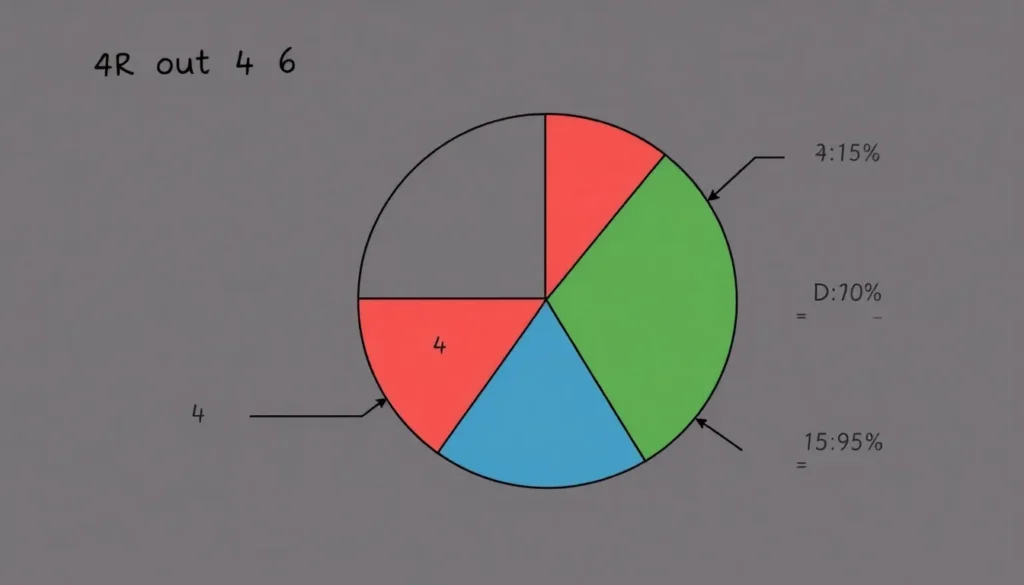
The simplest way to understand “4 out of 6” is to think of it as four pieces of a pie that is divided into six equal parts. If you take four of those parts, you have 4/6 of the pie, which is the same as two-thirds of it. Converting the fraction to a percentage (66.67%) can also help visualize how much of the whole is represented.
FAQ
What does 4 out of 6 mean in fraction form?
It represents the fraction 4/6, which can be simplified to 2/3.
How do you convert 4 out of 6 to a percentage?
Divide 4 by 6 to get approximately 0.6667, then multiply by 100 to get about 66.67%.
Is 4 out of 6 the same as 2 out of 3?
Yes, because 4/6 simplifies to 2/3, meaning they represent the same proportion.






Leave a Reply