
Short Answer
Overview
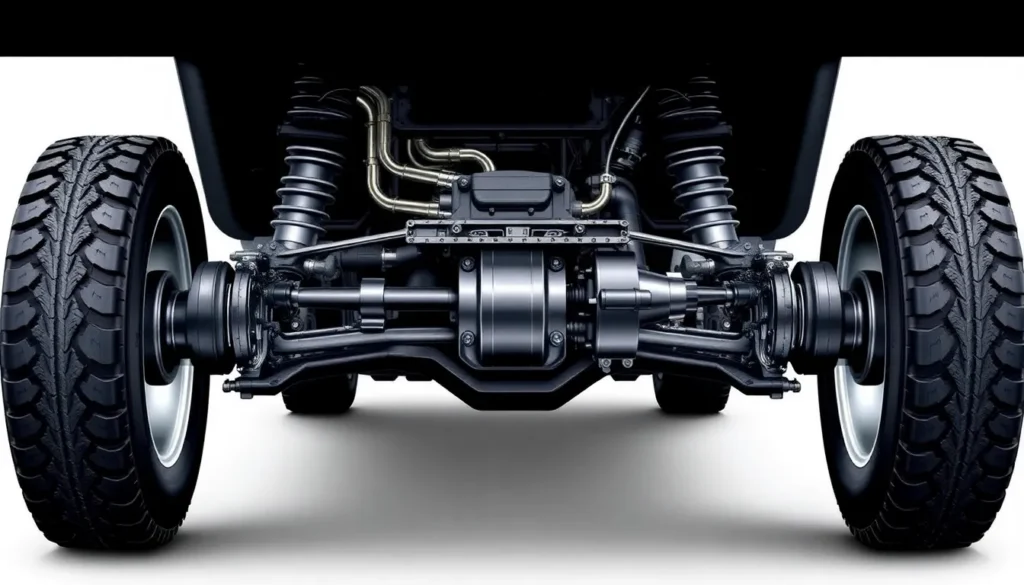
A 4×2 drivetrain refers to a vehicle configuration in which four wheels are present, but only two wheels receive power from the engine at a time. This is typically achieved by delivering power to either the rear two wheels or, less commonly, the front two wheels. The term “4×2” contrasts with other drivetrain layouts such as 4×4 or all-wheel drive (AWD), where all four wheels can receive power simultaneously.
Detailed Explanation
In a 4×2 drivetrain, the first number “4” denotes the total number of wheels on the vehicle, while the second number “2” identifies the number of wheels that are powered. Most commonly, 4×2 vehicles are rear-wheel drive (RWD), meaning the rear axle is powered. However, some vehicles have front-wheel drive (FWD) configurations, which are also considered 4×2 if only two wheels are driven.
This drivetrain layout is prevalent in many passenger vehicles, light trucks, and commercial vehicles due to its relatively simple mechanical design, lower cost, and lighter weight compared to four-wheel drive systems.
How It Works
The drivetrain system in a 4×2 vehicle transmits engine power to either the front or rear axle. In a rear-wheel drive setup, the engine’s power is sent through the transmission to a driveshaft, which turns the rear differential. The differential then distributes power to the two rear wheels, allowing them to rotate at different speeds when turning.
In front-wheel drive 4×2 vehicles, the engine’s power goes through the transmission and transaxle, directly driving the front wheels. This eliminates the need for a driveshaft running to the rear axle and typically results in better fuel efficiency and more cabin space.
Because only two wheels are powered, traction depends heavily on road conditions and weight distribution. On dry, paved roads, 4×2 drivetrains provide sufficient traction and handling for most driving situations.
Examples
- Toyota Camry: A popular midsize sedan with a front-wheel drive 4×2 layout.
- Ford F-150 (base models): Many base configurations of this light-duty pickup truck use a rear-wheel drive 4×2 drivetrain.
- Honda Accord: Another common example of a front-wheel drive 4×2 vehicle.
- Chevrolet Silverado 1500 (standard trim): Often equipped with rear-wheel drive 4×2 as the standard option.
Pros and Cons
- Pros:
- Simpler and less expensive drivetrain components compared to 4×4 or AWD systems.
- Generally lighter weight, which can improve fuel efficiency.
- Lower maintenance costs due to fewer mechanical parts.
- Effective traction on dry and paved roads.
- Cons:
- Reduced traction in off-road, snow, ice, or slippery conditions compared to all-wheel or four-wheel drive systems.
- Less versatility in challenging terrain or adverse weather.
- Potential for uneven tire wear if traction is limited on powered wheels.
Comparison Table
| Aspect | 4×2 Drivetrain | 4×4 Drivetrain |
|---|---|---|
| Meaning | Four wheels total, two wheels powered (front or rear). | Four wheels total, all four wheels powered. |
| Typical Use | Everyday driving, paved roads, light trucks, sedans. | Off-road, towing, rough terrain, trucks and SUVs. |
| Cost | Lower initial and maintenance cost. | Higher cost due to complex drivetrain components. |
| Traction | Good on dry roads; limited in slippery conditions. | Superior traction in diverse conditions including off-road. |
| Fuel Efficiency | Generally better due to lighter weight. | Generally lower due to increased drivetrain drag and weight. |
Decision Checklist
- Use this if: You primarily drive on paved roads, prioritize fuel economy, and want a lower-cost vehicle.
- Avoid this if: You frequently encounter off-road terrain, snow, or slippery driving conditions requiring enhanced traction.
- Check this first: Your typical driving environment and whether all-wheel or four-wheel drive capabilities are necessary for safety or performance.
What is the easiest way to understand a 4×2 drivetrain?
The simplest way to understand a 4×2 drivetrain is to remember that while the vehicle has four wheels, only two of those wheels receive engine power. This setup is common in everyday cars and trucks designed mainly for on-road use, providing efficient and straightforward power delivery without the complexity of powering all four wheels.
FAQ
What does 4x2 mean in a vehicle?
It means the vehicle has four wheels in total, but only two wheels receive power from the engine.
Is 4x2 better than 4x4?
Whether 4x2 is better depends on your driving conditions; 4x2 is simpler and more efficient on paved roads, while 4x4 offers better traction off-road or in slippery conditions.
Can a 4x2 vehicle handle snow and ice?
A 4x2 vehicle can handle light snow and ice with proper tires, but it generally has less traction than 4x4 or AWD vehicles in severe conditions.





Leave a Reply