
Short Answer
Overview
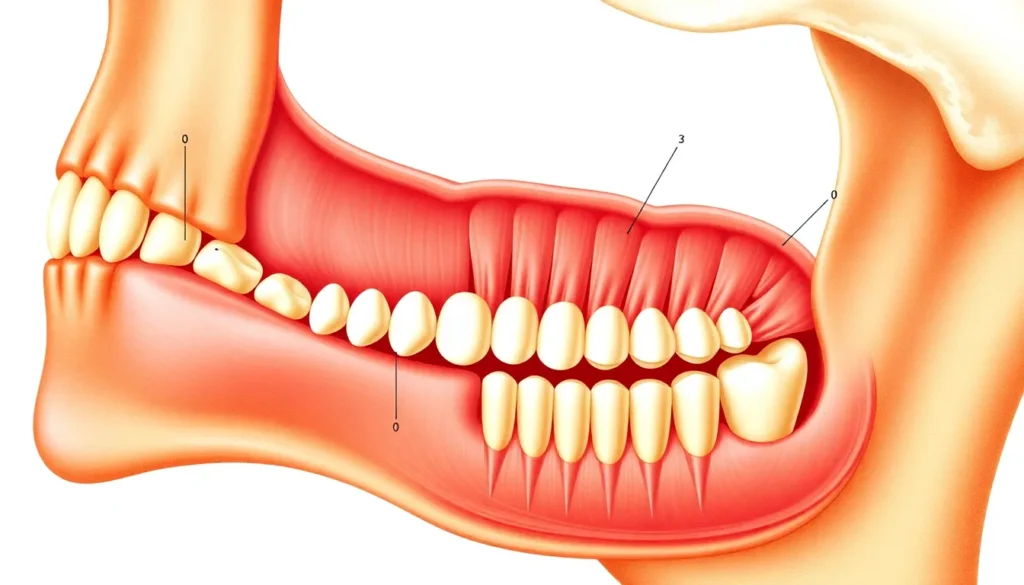
The dental arch refers to the curved formation created by the alignment of teeth in either the maxilla (upper jaw) or mandible (lower jaw). It is a fundamental anatomical feature of the human oral cavity, essential for proper mastication, speech, and aesthetics. The dental arches support the teeth and contribute to the overall shape of the mouth and face.
Detailed Explanation
Human beings have two primary dental arches: the maxillary arch (upper jaw) and the mandibular arch (lower jaw). Each arch contains a specific number of teeth arranged in a semi-elliptical curve. The maxillary arch is generally wider and more fixed due to its connection to the skull, while the mandibular arch is more mobile, allowing for jaw movement.
The dental arch comprises various types of teeth, including incisors, canines, premolars, and molars. The arrangement and spacing of these teeth within the arch are critical for efficient biting, chewing, and maintaining occlusion—the contact between upper and lower teeth.
How It Works
The dental arch functions as a structural guide for the placement and movement of teeth. It ensures that the teeth are properly aligned to meet the opposing arch, facilitating effective chewing and speech. The shape and size of the dental arch influence how forces are distributed during biting and chewing, affecting the health of the teeth, gums, and jawbone.
During development, the dental arches form from the underlying jawbones and the dental lamina, a band of epithelial tissue. The growth and shape of the arches can be influenced by genetic factors, habits such as thumb sucking, or medical conditions affecting oral structures.
Examples
- Normal Dental Arch: A well-aligned, symmetrical arch with even spacing, enabling optimal function and appearance.
- Malocclusion: An irregular dental arch alignment causing misfit between upper and lower teeth, which can lead to difficulties in chewing and speech.
- Orthodontic Treatment: Procedures such as braces or clear aligners aim to modify the shape and alignment of dental arches to improve occlusion and aesthetics.
Why It Matters
The dental arch is crucial for oral health and function. Proper arch form and alignment help prevent dental problems such as tooth decay, gum disease, and temporomandibular joint disorders. Additionally, the dental arch influences facial aesthetics and speech clarity. Understanding dental arches aids dental professionals in diagnosing bite problems and planning effective treatments.
Common Misconceptions
Misconception: The dental arch only refers to the teeth themselves.
Correction: The dental arch encompasses both the teeth arrangement and the underlying jawbone structure that supports them.
Misconception: The shape of the dental arch is the same for everyone.
Correction: Dental arch shapes vary widely among individuals due to genetics, age, and environmental factors.
Pros and Cons
Comparison Table
| Aspect | Dental Arch | Jawbone |
|---|---|---|
| Meaning | Curved arrangement of teeth within upper or lower jaw | Bone structure that forms the upper or lower jaw |
| Function | Supports teeth alignment and occlusion | Provides structural support and houses dental arches |
| Mobility | Teeth alignment within a relatively fixed shape | Mandible is mobile; maxilla is fixed |
Decision Checklist
- Use this if: You need to understand the structural basis of tooth arrangement and occlusion.
- Avoid this if: Your focus is solely on individual teeth or jawbones without regard to their arrangement.
- Check this first: The alignment, shape, and size of the dental arches before dental or orthodontic treatment.
What is the easiest way to understand Dental Arch?
The simplest way to understand a dental arch is to visualize the curved row of teeth in either the upper or lower jaw and recognize it as the foundational structure that maintains proper tooth positioning and facilitates essential oral functions like biting, chewing, and speaking.
FAQ
What is the difference between the maxillary and mandibular dental arches?
The maxillary dental arch is the curved arrangement of teeth in the upper jaw and is generally wider and fixed, while the mandibular dental arch is in the lower jaw and is more mobile due to the mandible's movement.
Why is the dental arch important for oral health?
The dental arch ensures proper alignment and spacing of teeth, facilitating effective chewing, speech, and maintenance of facial structure, while also reducing the risk of dental diseases.
Can dental arches change shape over time?
Yes, dental arches can change shape due to growth, tooth loss, orthodontic treatment, or habits such as thumb sucking, which can affect alignment and occlusion.





Leave a Reply