
Short Answer
Overview
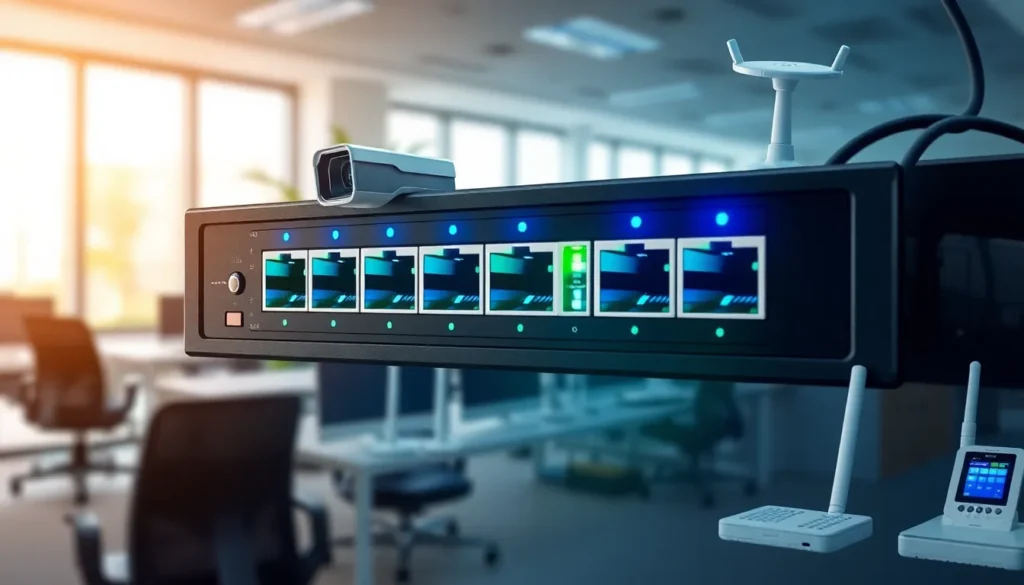
A managed 8 PoE hybrid PoE switch is a networking hardware device designed to provide both power and data connectivity to compatible devices over Ethernet cables. It features eight ports capable of delivering Power over Ethernet (PoE), and offers management functionalities that allow administrators to monitor, configure, and control the network traffic and power distribution. The term “hybrid PoE” generally refers to the switch’s ability to support multiple PoE standards, such as IEEE 802.3af (PoE), IEEE 802.3at (PoE+), and sometimes proprietary or higher wattage standards, enabling compatibility with a wide range of powered devices.
Detailed Explanation
Power over Ethernet (PoE) technology allows network cables to carry electrical power alongside data, simplifying the installation of devices like IP cameras, wireless access points, and VoIP phones by eliminating the need for separate power supplies. A managed PoE switch adds a layer of control over the network by offering features such as VLAN configuration, Quality of Service (QoS), port mirroring, and link aggregation.
An 8-port PoE switch indicates that eight individual ports can provide both power and data. The “hybrid” aspect typically means the switch supports multiple PoE standards or can combine PoE with non-PoE ports, or that it can deliver varying power levels depending on device requirements. This flexibility makes it suitable for mixed environments with devices of different power demands.
How It Works
The switch connects to a local area network (LAN) via uplink ports and distributes network data and power to connected devices through its PoE-enabled ports. When a PoE-capable device is connected, the switch detects its power requirements using a discovery protocol such as the IEEE 802.3af/at standards and supplies the appropriate amount of power.
Management features allow network administrators to configure power allocation per port, monitor power consumption, prioritize traffic, and secure the network. Hybrid PoE switches may dynamically allocate power depending on the device’s standard or support a mix of powered and non-powered devices on different ports.
Examples
- An office deploying IP telephones and wireless access points can use a managed 8 PoE hybrid PoE switch to centralize control and power supply, reducing cable clutter and easing device management.
- A security system setup with IP cameras of varying power requirements can benefit from a hybrid PoE switch that supports both standard PoE and PoE+ devices.
- Small to medium-sized businesses often use these switches to manage their local network efficiently, enabling remote configuration and monitoring.
Pros and Cons
Pros:
- Centralized power and data delivery reduces infrastructure complexity.
- Management features enhance network control and security.
- Hybrid PoE support increases compatibility with diverse devices.
- Eight ports offer sufficient connectivity for small to medium networks.
Cons:
- Higher cost compared to unmanaged or non-PoE switches.
- Power budget limitations may restrict the number or type of devices powered simultaneously.
- Requires network knowledge to fully utilize management features.
Comparison Table
| Aspect | Managed 8 PoE Hybrid PoE Switch | Unmanaged PoE Switch |
|---|---|---|
| Meaning | A switch with eight PoE ports supporting multiple PoE standards and management capabilities. | A plug-and-play switch providing PoE without management features. |
| Power Standards | Supports IEEE 802.3af, 802.3at, and possibly proprietary standards. | Typically supports only IEEE 802.3af or limited PoE standards. |
| Management | Full network management including VLANs, QoS, and monitoring. | No management; basic connectivity only. |
| Use Case | Suitable for complex environments requiring control and diverse devices. | Suitable for simple setups with uniform device requirements. |
Decision Checklist
- Use this if you need centralized control of network devices and power delivery along with support for multiple PoE standards.
- Avoid this if your network is very small, simple, or budget constrained, and does not require management features.
- Check this first if your powered devices require different PoE standards or higher power levels, and confirm the switch’s power budget per port.
What is the easiest way to understand a Managed 8 PoE Hybrid PoE Switch?
Think of it as a smart power strip for network devices: it not only provides electricity and data connectivity through the same cables to up to eight devices but also lets you control and monitor how each device uses power and data, supporting various power standards to accommodate different device types.
FAQ
What does 'hybrid PoE' mean in a switch?
Hybrid PoE typically refers to a switch's ability to support multiple PoE standards or a mix of PoE and non-PoE ports, offering flexibility in powering different devices.
Can a managed 8 PoE hybrid PoE switch power all connected devices simultaneously?
This depends on the switch's total power budget and the power requirements of each device. Administrators must ensure the total power consumption does not exceed the switch's capacity.
Why choose a managed PoE switch over an unmanaged one?
Managed PoE switches allow for network monitoring, configuration, and enhanced security, which are essential for complex or larger networks requiring reliability and control.




Leave a Reply