
Short Answer
Overview
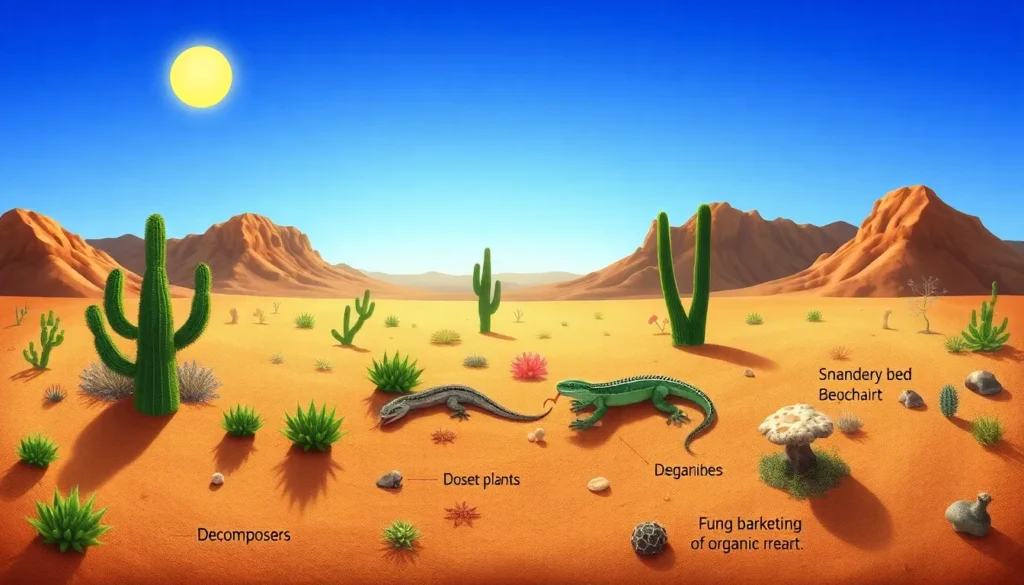
A food chain in the desert is a model that depicts the transfer of energy and nutrients from one organism to another within a desert ecosystem. Despite the harsh conditions characterized by limited water and extreme temperatures, deserts support a variety of life forms that interact in complex feeding relationships. These food chains typically begin with primary producers, such as desert plants and photosynthetic microorganisms, and proceed through herbivores, carnivores, and decomposers.
Detailed Explanation
Desert food chains are adapted to the scarcity of water and vegetation. Primary producers, including cacti, shrubs, grasses, and algae, convert sunlight into energy through photosynthesis. Herbivores such as insects, rodents, and reptiles consume these plants. Carnivores, including snakes, birds of prey, and larger mammals, feed on herbivores or other carnivores. Decomposers like fungi and bacteria play an essential role by breaking down dead organic matter, recycling nutrients back into the soil to support new plant growth.
How It Works
Energy flows through the desert food chain starting with the sun, which provides energy to producers. These producers create organic material that herbivores consume. Carnivores then prey on herbivores, and some carnivores may be apex predators at the top of the chain. Decomposers complete the cycle by decomposing dead plants and animals, facilitating nutrient cycling. Each step involves energy loss, primarily as heat, limiting the length of desert food chains, which tend to be shorter than those in more temperate ecosystems.
Examples
- Simple Desert Food Chain: Sun → Cactus (producer) → Desert Iguana (herbivore) → Rattlesnake (carnivore) → Bacteria (decomposer)
- Complex Desert Food Chain: Sun → Creosote Bush → Grasshopper → Roadrunner → Coyote → Fungi
- Microbial Food Chain: Sunlight → Cyanobacteria → Protozoa → Microarthropods → Decomposers
Why It Matters
Understanding food chains in the desert is crucial for appreciating the delicate balance of life in arid environments. It highlights the interdependence of organisms and the importance of conserving desert habitats, which are vulnerable to climate change and human activities. Knowledge of these chains also aids in ecological research and wildlife management, helping to maintain biodiversity and ecosystem function.
Common Misconceptions
Misconception: The desert has no food chains because of its barren appearance.
Correction: Despite harsh conditions, deserts support complex food chains involving specialized plants and animals.
Misconception: All desert animals are herbivores.
Correction: Desert ecosystems include herbivores, carnivores, omnivores, and decomposers, all contributing to the food chain.
Pros and Cons
Pros: Desert food chains demonstrate adaptation to extreme environments and contribute to ecosystem stability. They support biodiversity by linking various organisms in energy flow and nutrient cycling.
Cons: These food chains are often fragile due to limited resources and can be easily disrupted by environmental changes or human interference, leading to ecosystem imbalance.
Comparison Table
| Aspect | Desert Food Chain | Forest Food Chain |
|---|---|---|
| Meaning | Sequence of organisms transferring energy in arid ecosystems with limited water and vegetation. | Sequence of organisms transferring energy in densely vegetated, moist ecosystems. |
| Length | Generally shorter due to resource scarcity. | Typically longer with more trophic levels. |
| Key Producers | Cacti, shrubs, grasses, algae. | Trees, shrubs, ferns, mosses. |
| Dominant Consumers | Insects, reptiles, small mammals, birds of prey. | Insects, mammals, birds, amphibians. |
| Decomposers | Fungi, bacteria adapted to dry conditions. | Fungi, bacteria in moist soil. |
Decision Checklist
What is the easiest way to understand a Food Chain for the Desert?
The simplest way to understand a desert food chain is to visualize it as a stepwise transfer of energy starting from the sun to plants (producers), which are eaten by herbivores, which in turn are eaten by carnivores, ending with decomposers recycling organic matter. Drawing or studying specific examples of desert organisms in these roles can clarify these relationships.
FAQ
What organisms start a desert food chain?
Desert food chains typically start with primary producers such as cacti, shrubs, grasses, and photosynthetic microorganisms that convert sunlight into energy.
How do desert animals survive with limited water?
Desert animals have adapted behavioral and physiological traits such as nocturnal activity, water retention, and specialized diets to survive with limited water availability.
Why are desert food chains usually shorter than those in other ecosystems?
Desert food chains tend to be shorter due to limited energy input and scarce resources, which restrict the number of trophic levels that can be supported.


Leave a Reply