
Short Answer
Overview
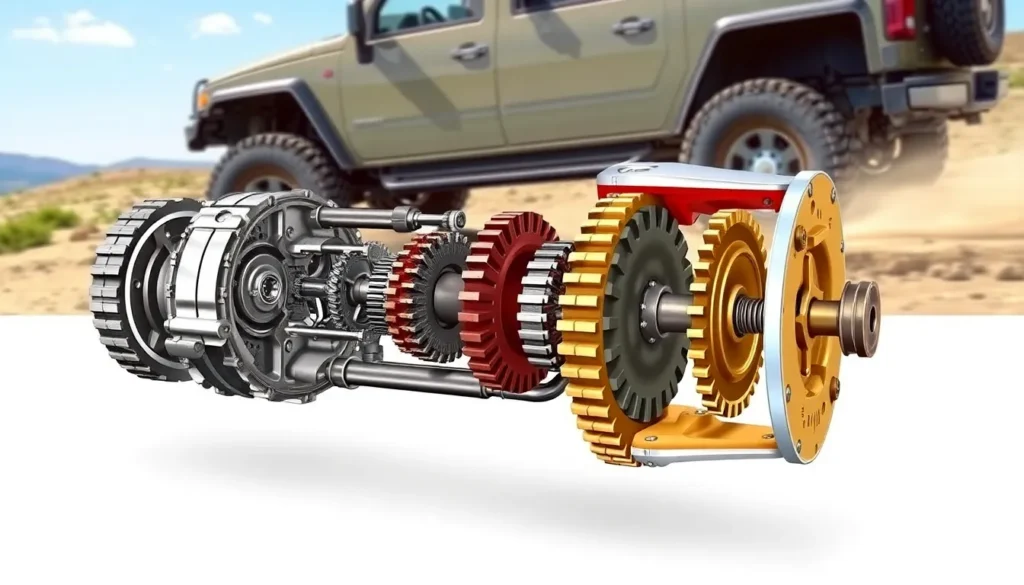
A transfer case is a vital component in many four-wheel drive (4WD) and all-wheel drive (AWD) vehicles. It is a mechanical device that receives power from the vehicle’s transmission and distributes it to both the front and rear axles. By managing the flow of power, the transfer case enables a vehicle to effectively operate in different driving conditions, including off-road, slippery, or uneven terrain. This component is essential for providing enhanced traction and stability.
Detailed Explanation
The transfer case is typically mounted directly behind the transmission and is connected to both the transmission output shaft and the front and rear drive shafts. It contains gears, chains, or a combination of both, which allow it to split engine power between the front and rear axles. Depending on the design, it can also provide different gear ratios, such as a low-range gear for increased torque during off-road driving.
Transfer cases come in various configurations, including part-time 4WD, full-time 4WD, and AWD systems. Part-time 4WD transfer cases allow the driver to switch between two-wheel drive (2WD) and 4WD modes, whereas full-time 4WD transfer cases constantly send power to all wheels. AWD transfer cases typically allow variable torque distribution to optimize traction automatically.
How It Works
When the engine generates power, this power is transmitted through the transmission to the transfer case. The transfer case then divides this power and sends it to the front and rear axles via drive shafts. The mechanism inside the transfer case determines how much power is sent to each axle.
In some transfer cases, the driver can manually select modes, such as 2WD, 4WD high, or 4WD low. Engaging 4WD low gear provides increased torque at lower speeds, useful for climbing steep inclines or traversing difficult terrain. In contrast, AWD systems often use electronic controls and sensors to adjust torque distribution dynamically, improving vehicle handling and safety without driver input.
Examples
- Part-Time Transfer Case: Found in traditional off-road vehicles like older Jeep models, this type requires the driver to manually engage 4WD modes, typically accompanied by a low-range gear for tough conditions.
- Full-Time Transfer Case: Used in vehicles like the Toyota Land Cruiser, this type sends power to all wheels continuously and often includes a center differential to allow differences in wheel speed between front and rear axles.
- All-Wheel Drive Transfer Case: Common in modern crossovers and SUVs, such as the Subaru Outback, which uses an electronically controlled transfer case to vary torque between front and rear wheels based on traction needs.
Pros and Cons
- Pros:
- Improves vehicle traction and stability across various terrains.
- Provides low-range gearing for enhanced torque in difficult driving conditions.
- Enables driver control over power distribution in selectable systems.
- Can enhance safety in slippery or off-road environments.
- Cons:
- Adds complexity and weight to the drivetrain system.
- Can increase fuel consumption due to additional mechanical components.
- Requires maintenance and occasional repairs, which may be costly.
- Improper use of part-time 4WD transfer cases can lead to drivetrain damage.
Comparison Table
| Aspect | Transfer Case | Alternative/Related Topic (Differential) |
|---|---|---|
| Meaning | A device that splits power from the transmission to front and rear axles in 4WD/AWD vehicles. | A mechanical component that distributes torque between wheels on the same axle while allowing different wheel speeds. |
| Primary Function | Manage power distribution between front and rear axles. | Manage power distribution between left and right wheels on an axle. |
| Common Use | 4WD and AWD vehicles for off-road and variable traction conditions. | All vehicles with multiple wheels to enable smooth cornering. |
| Control | Can be manual (selectable modes) or automatic (electronic control). | Typically mechanical or limited-slip, rarely driver-controlled. |
| Complexity | More complex, involving gears and sometimes chains or electronics. | Less complex, primarily gear-based mechanisms. |
Decision Checklist
- Use this if… you drive in off-road, slippery, or challenging terrain needing improved traction and control.
- Avoid this if… your driving is primarily on paved roads and you prioritize fuel economy and lower maintenance.
- Check this first… your vehicle’s drivetrain configuration and whether it includes or requires a transfer case for your driving needs.
What is the easiest way to understand a Transfer Case?
Think of a transfer case as a power splitter for a vehicle. It takes the engine’s power after it passes through the transmission and sends it to both the front and rear wheels. This ability to send power to multiple axles helps the vehicle maintain traction on slippery or uneven surfaces, much like how a team works together to get through a difficult path more effectively than an individual.
FAQ
What is the primary purpose of a transfer case?
The primary purpose of a transfer case is to distribute power from the transmission to both the front and rear axles in four-wheel drive or all-wheel drive vehicles, enabling improved traction and control.
Can a vehicle operate without a transfer case?
Vehicles with two-wheel drive typically do not have a transfer case because power is delivered to only one axle. However, four-wheel drive and all-wheel drive vehicles generally require a transfer case to properly distribute power to multiple axles.
What is the difference between part-time and full-time transfer cases?
Part-time transfer cases allow the driver to switch between two-wheel drive and four-wheel drive modes, often including a low-range gear for off-road use. Full-time transfer cases send power to all wheels continuously and usually feature a center differential to accommodate differences in wheel speeds during turns.


Leave a Reply