
Short Answer
Overview
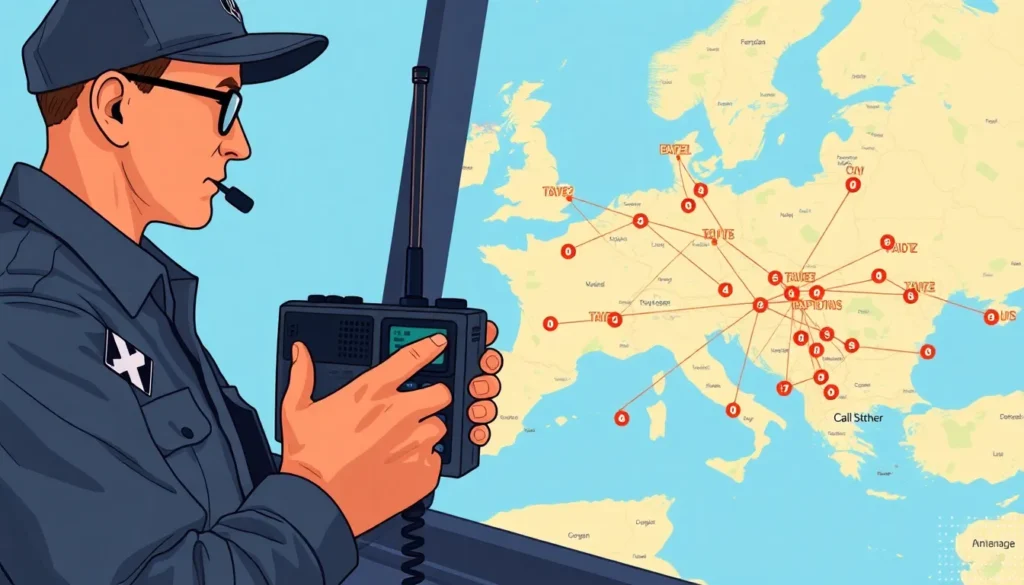
A Civil Air Patrol (CAP) relay callsign is a specialized radio identifier used during CAP communications to facilitate the relay of messages between multiple stations. These callsigns form an integral part of CAP’s structured communication network, especially during search and rescue missions, disaster relief, and other operational activities where message transmission must pass through several intermediate stations.
Detailed Explanation
Relay callsigns in the Civil Air Patrol are employed to maintain clarity and order in radio traffic when messages cannot be sent directly from the origin to the destination. In such scenarios, the message is passed sequentially through a chain of operators or stations. Each relay callsign uniquely identifies a station in this chain, allowing operators to track message progress and maintain communication discipline.
How It Works
When a message originates at a CAP station that cannot directly contact the intended recipient, it is relayed through one or more intermediate stations. Each station in this relay chain uses a relay callsign that typically includes a combination of letters and numbers indicating the station’s identity and its position in the communication network. Operators use these callsigns to acknowledge receipt, confirm forwarding, and manage message flow, reducing confusion and preventing message loss.
Examples
- Example 1: A message from CAP Station Alpha may be relayed through Station Bravo before reaching Station Charlie. The relay callsigns might be “Alpha Relay,” “Bravo Relay,” and “Charlie Relay,” respectively.
- Example 2: During a large-scale emergency, a relay callsign like “Base Relay 1” might be used to designate the primary relay station coordinating multiple field units.
- Example 3: Numeric suffixes can be added to indicate multiple relay points at the same location, such as “Eagle Relay 2” denoting the second relay station at the Eagle base.
Why It Matters
Relay callsigns are critical for maintaining effective communication within the Civil Air Patrol, particularly in complex operations where direct communication is not possible. They help prevent message overlap, ensure proper routing, and allow accountability for each transmission step. This system enhances operational efficiency and safety.
Common Misconceptions
Misconception: Relay callsigns are interchangeable with regular CAP callsigns.
Correction: Relay callsigns are distinct and used specifically to identify stations during message relays, whereas regular CAP callsigns identify units or individuals.
Misconception: Relay callsigns are used only for high-level command communication.
Correction: Relay callsigns are used at various levels within CAP operations, wherever message relaying is necessary.
Pros and Cons
Comparison Table
| Aspect | Civil Air Patrol Relay Callsign | Regular CAP Callsign |
|---|---|---|
| Meaning | Identifier used specifically to relay messages through intermediate stations | Identifier for a CAP unit, individual, or station |
| Usage | Used during message relaying to manage communication flow | Used to call or identify units during routine communication |
| Format | Typically includes “Relay” and unique identifiers or numeric suffixes | Usually alphanumeric codes or names assigned to units |
Decision Checklist
- Use this if you need to relay messages through multiple CAP stations reliably.
- Avoid this if direct communication between sender and receiver is possible without intermediates.
- Check this first whether the relay chain is necessary and if all stations are equipped and trained to use relay callsigns.
What is the easiest way to understand Civil Air Patrol relay callsigns?
The easiest way to understand relay callsigns is to view them as a “telephone game” chain in radio communication, where each station in the chain has a unique identifier ensuring the message is passed correctly from start to finish without confusion.
FAQ
What is the primary purpose of a relay callsign in CAP?
The primary purpose is to identify intermediate stations during the relay of messages, ensuring clear and orderly communication flow.
Are relay callsigns used only during emergencies?
No, relay callsigns are used whenever message relaying is necessary, not solely during emergencies.
How are relay callsigns different from standard CAP callsigns?
Relay callsigns specifically denote stations involved in message relaying, whereas standard CAP callsigns identify units or individuals for general communication.




Leave a Reply