
Short Answer
Overview
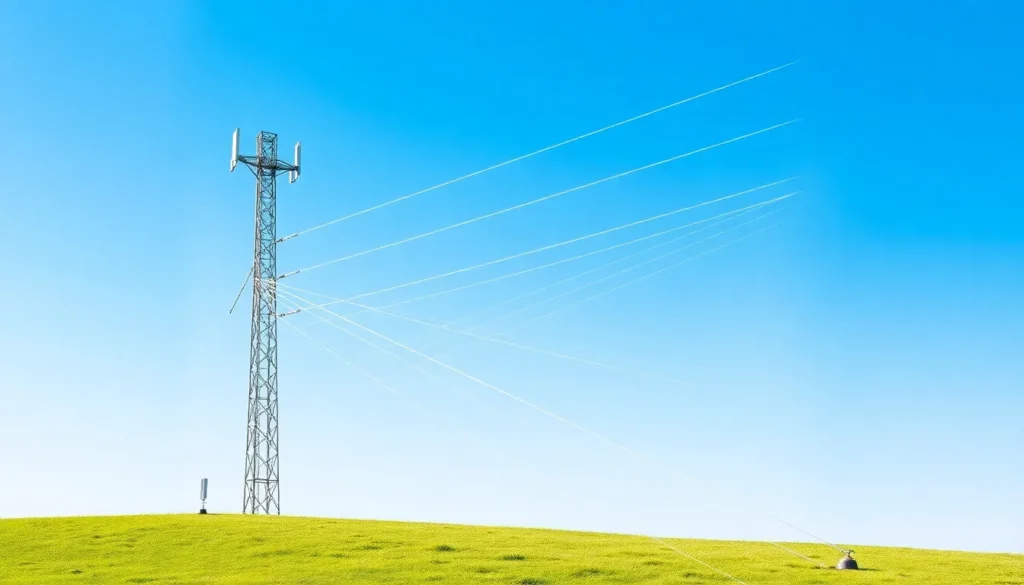
A guy wire, also known as a guy cable or stay cable, is a tensioned cable designed to add stability and support to tall or slender structures. These wires are anchored to the ground or another fixed point, providing lateral support that helps prevent bending, swaying, or collapse due to environmental forces such as wind, gravity, or ice load. Guy wires are commonly used in telecommunications towers, utility poles, radio masts, and various types of antennas.
Detailed Explanation
Guy wires are typically made from galvanized steel or other high-strength metal cables. They are anchored at one end to the structure and at the other end to a ground anchor or foundation, maintaining a specific angle to maximize their stabilizing effect. The tension in the wires counteracts forces that act on the structure, distributing stress and ensuring structural integrity. Their installation requires precise engineering calculations to determine the appropriate length, tension, and placement.
How It Works
The fundamental principle behind guy wires is tension. When external forces apply pressure to the structure, the guy wires resist movement by staying taut. This tension acts to counterbalance bending moments and lateral forces, reducing the risk of structural deformation. By anchoring multiple guy wires around a structure, usually spaced evenly in a radial pattern, the structure gains multidirectional support. Adjusting the tension allows for fine-tuning the stability and alignment of the supported structure.
Examples
- Telecommunications Towers: Tall radio and cell phone towers often rely on multiple guy wires to remain upright and withstand wind loads.
- Utility Poles: Guy wires stabilize poles carrying electrical or telephone lines, particularly in areas prone to strong winds or uneven terrain.
- Temporary Structures: Guy wires can provide support for tents, stage lighting rigs, or temporary antennas by anchoring them securely to the ground.
Why It Matters
Guy wires are critical in ensuring the safety and longevity of many tall, slender structures. By preventing excessive movement, they reduce the risk of structural failure, property damage, and potential injury. Their relatively low cost and ease of installation make them an efficient solution for structural support where rigid frameworks are impractical or too expensive.
Common Misconceptions
Misconception: Guy wires are only used for very tall structures.
Correction: While commonly associated with tall towers, guy wires are also used for shorter poles and temporary structures to provide stability.
Misconception: Guy wires can be installed without precise engineering.
Correction: Proper tension, angle, and anchoring require careful calculation to ensure the structure’s safety and performance.
Pros and Cons
Comparison Table
| Aspect | Guy Wire | Alternative/Related Topic (Rigid Support) |
|---|---|---|
| Meaning | Tensioned cable providing lateral support | Rigid structural element fixed to the base or frame |
| Flexibility | Allows some movement but resists displacement | Provides fixed, inflexible support |
| Installation | Requires anchoring and tensioning | Requires structural connection and foundation |
| Space Requirement | Needs area for anchor points around structure | Minimal surrounding space needed |
| Cost | Generally lower cost and easier to install | Often higher cost due to materials and construction |
Decision Checklist
- Use this if you need economical lateral support for tall or slender structures and have sufficient space for anchors.
- Avoid this if space is limited around the structure or if aesthetics require no visible external supports.
- Check this first the required tension, angle, and anchor strength to ensure safe installation.
What is the easiest way to understand Guy Wire?
The easiest way to understand a guy wire is to think of it as a strong rope tied from a tall pole to the ground at an angle, pulling the pole taut to keep it from falling over when pushed by wind or other forces.
FAQ
What materials are guy wires made of?
Guy wires are usually made from galvanized steel or other high-strength metal cables to ensure durability and resistance to environmental conditions.
Why are guy wires necessary for tall structures?
Guy wires provide lateral support to counteract forces such as wind and weight that could cause the structure to bend, sway, or collapse.
Can guy wires be used for temporary structures?
Yes, guy wires are often used to stabilize temporary structures like tents or temporary antennas because they provide reliable support and can be installed and removed easily.



Leave a Reply