
Short Answer
Overview
In culinary contexts, a binder is an ingredient that helps hold other ingredients together, providing structural integrity and cohesion to a dish. Binders are essential in recipes where individual components need to maintain their shape or consistency, such as in meatballs, burgers, baked goods, and certain sauces. By preventing ingredients from separating or crumbling, binders contribute to the overall texture and presentation of the food.
Detailed Explanation
Binders function by creating a matrix or network that envelops and connects various particles or components within a mixture. This is particularly important in recipes that combine dry and moist ingredients, where the binder ensures uniformity and stability during cooking or baking. The nature of binders can vary widely depending on the dish and desired outcome; they may be protein-based (such as eggs), carbohydrate-based (such as flour or starches), or gel-forming agents (such as gelatin or agar).
Binders can also influence the moisture retention, mouthfeel, and shelf life of food products. In processed foods, they are often used to maintain consistency and improve texture. The selection of an appropriate binder depends on factors including dietary restrictions, desired texture, cooking method, and flavor compatibility.
How It Works
The binding effect arises from the physical and chemical properties of the binder. For example, eggs contain proteins that coagulate when heated, forming a solid network that traps other ingredients. Flour and starches absorb moisture and swell, creating viscosity that holds components together. Gelatin forms a gel when cooled, providing firmness and cohesion. This network formation prevents separation and crumbling, allowing the food to maintain its intended shape and texture.
The effectiveness of a binder depends on its concentration, the temperature applied during cooking, and interactions with other ingredients. Overuse or underuse of binders can lead to undesirable results such as overly dense textures or crumbly products.
Examples
- Eggs: Frequently used in meatloaf, meatballs, and baked goods to provide structure and moisture retention.
- Flour: Acts as a thickening and binding agent in doughs, batters, and sauces.
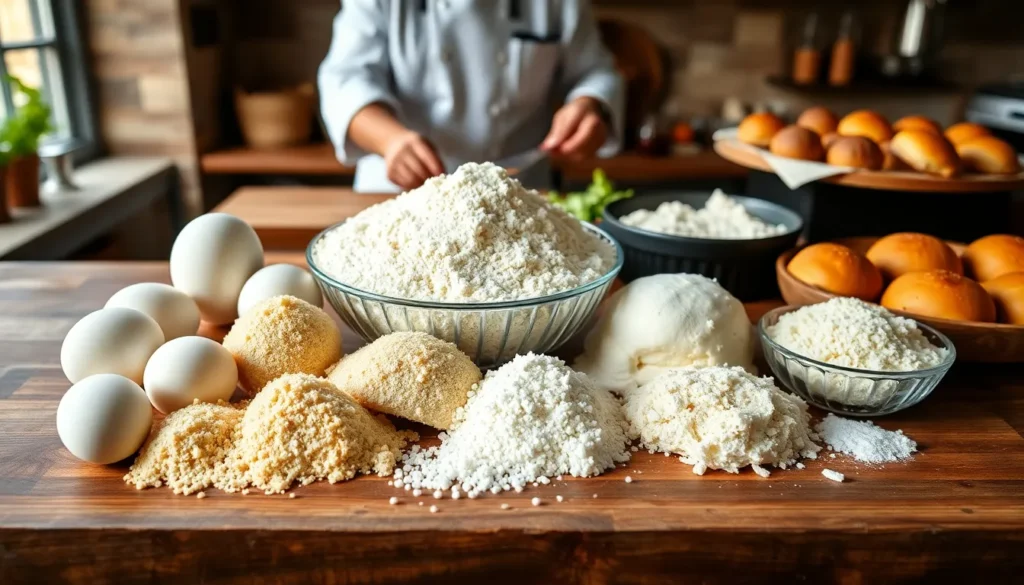
- Breadcrumbs: Commonly used in conjunction with eggs in meat mixtures to absorb moisture and prevent crumbling.
- Starches: Such as cornstarch, potato starch, and arrowroot, used to thicken and bind sauces, fillings, and gluten-free baking.
- Gelatin: Used to stabilize mousses, aspics, and certain desserts by forming gels upon cooling.
- Nut butters: Sometimes used as binders in raw or vegan recipes to hold ingredients together.
Why It Matters
Binders are fundamental in cooking and baking because they determine the texture, consistency, and structural integrity of many dishes. Without appropriate binders, foods can fall apart, become dry, or exhibit an undesirable mouthfeel. Understanding binders enables cooks to manipulate recipes effectively, ensuring that ingredients combine harmoniously and the final product meets expectations in terms of appearance and palatability.
Additionally, binders can be adapted to accommodate dietary needs, such as vegan or gluten-free alternatives, broadening the accessibility of diverse culinary preparations.
Common Misconceptions
Misconception: All binders add strong flavor to dishes.
Correction: Many binders, such as flour or starches, are neutral in flavor and primarily affect texture rather than taste.
Misconception: Eggs are the only effective binder.
Correction: While eggs are common binders, many other ingredients like starches, gelatin, and plant-based alternatives also serve this function effectively.
Pros and Cons
Comparison Table
| Aspect | Binder | Alternative/Related Topic |
|---|---|---|
| Meaning | Ingredient that holds other ingredients together, providing structure | Thickener – ingredient that increases viscosity without necessarily providing structure |
| Common Types | Eggs, flour, starches, gelatin | Leavening agents – ingredients that cause rising, e.g., baking powder, yeast |
| Effect on Texture | Creates cohesion and firmness | Adds moisture or airiness without binding |
Decision Checklist
- Use this if you need to hold ingredients together, prevent crumbling, or improve texture.
- Avoid this if you want a loose, crumbly, or pourable texture without firmness.
- Check this first for dietary considerations (e.g., allergies, vegan preferences) and compatibility with other ingredients.
What is the easiest way to understand binders in cooking?
The simplest way to grasp the concept of binders is to think of them as the “glue” in food preparation. Just as glue holds materials together, binders hold food components united to create a cohesive and stable final dish.
FAQ
What is the main purpose of a binder in cooking?
The main purpose of a binder is to hold ingredients together, providing cohesion and structure to a dish, preventing it from falling apart during preparation or cooking.
Can binders be used in vegan cooking?
Yes, there are many plant-based binders such as flaxseed meal, chia seeds, nut butters, and commercial vegan binding agents that can substitute for traditional binders like eggs or gelatin.
Are binders the same as thickeners?
No, binders primarily hold solid components together, while thickeners increase the viscosity of liquids. Sometimes an ingredient can act as both, but their primary functions differ.






Leave a Reply