
Short Answer
Overview
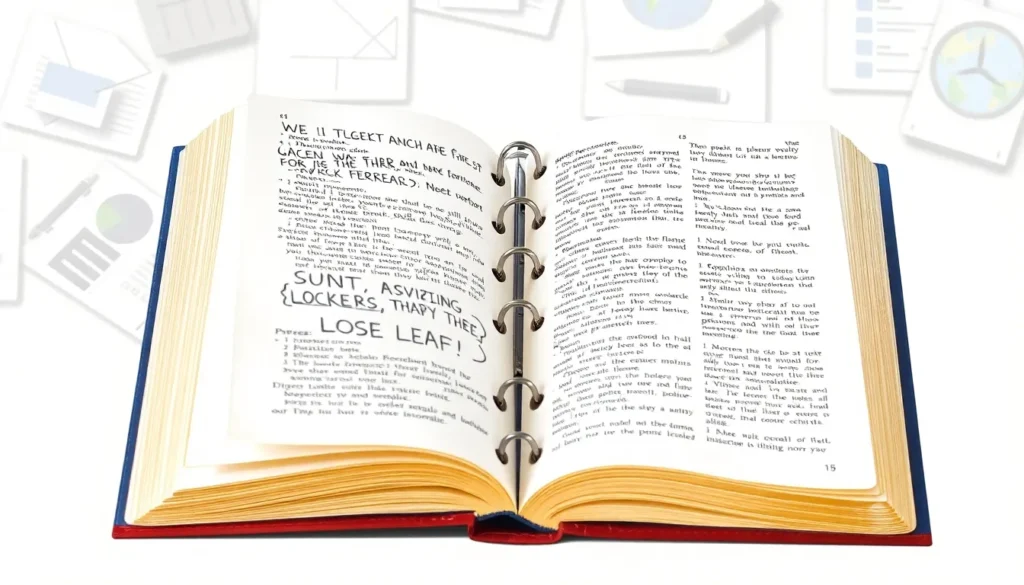
A loose leaf textbook is a type of educational material comprised of individual pages that are not permanently bound together. Instead, the pages are typically held within a binder or ring system, allowing users to add, remove, or rearrange the content as needed. This format offers a flexible alternative to traditional bound textbooks, enabling easier updates and customization. Loose leaf textbooks are commonly used in academic environments such as schools and universities.
Detailed Explanation
Unlike conventional textbooks that are bound with glue, stitching, or spiral bindings, loose leaf textbooks consist of punched sheets designed to be inserted into a three-ring binder or similar binding mechanism. The pages are usually printed on standard paper stock and are produced in sets or modules. This format allows instructors or students to tailor the material to specific courses or needs by selecting relevant chapters or sections.
Loose leaf textbooks may be sold with a binder included or separately, depending on the publisher. They often facilitate cost savings as only individual pages may be replaced or updated, rather than purchasing an entirely new edition. Additionally, loose leaf textbooks can be combined with supplementary materials such as workbooks, lab manuals, or study guides, enhancing their modular nature.

How It Works
Users receive loose leaf textbooks as a collection of loose pages, often pre-punched with holes to fit standard binders. The pages are inserted into the binder rings, which can be opened to add, remove, or reorder pages. This system allows for updates to be made simply by replacing specific pages rather than the entire book.
Instructors may distribute customized versions by selecting only relevant chapters or sections for a particular class. Students benefit from the ability to carry only necessary materials and to reorganize content to suit their study preferences. Additionally, damaged or lost pages can be replaced without discarding the entire textbook.
Examples
- College Courses: Many university courses offer loose leaf textbooks to accommodate evolving curricula or to provide students with affordable options.
- Professional Training: Technical or vocational training programs may use loose leaf textbooks to update information frequently without reprinting entire volumes.
- Custom Course Packs: Some educational institutions create custom course packs by compiling selected chapters from various textbooks in loose leaf format.
Pros and Cons
Pros:
- Flexibility to add, remove, or reorder pages
- Cost-effective updates and replacements
- Customization for specific courses or needs
- Portability by carrying only necessary sections
Cons:
- Potential for pages to become lost or damaged
- Less durable than traditionally bound textbooks
- Binder bulkiness can be inconvenient
- May lack the professional appearance of a bound book
Comparison Table
| Aspect | Loose Leaf Textbook | Bound Textbook |
|---|---|---|
| Meaning | Individual pages held together by a binder or rings | Pages permanently bound by glue, stitching, or spiral |
| Flexibility | High; pages can be added, removed, or rearranged | Low; fixed page order and content |
| Durability | Moderate; pages vulnerable to damage or loss | High; sturdy and long-lasting |
| Customization | Possible; tailored selection of chapters | Limited; fixed content for all users |
| Cost Efficiency | Potential savings on updates and replacements | Often more expensive to replace entire book |
Decision Checklist
- Use this if you require flexibility in content selection and frequent updates.
- Avoid this if you need a durable, professionally bound textbook for long-term use.
- Check this first if your course or institution supports loose leaf textbook formats and offers compatible materials.
What is the easiest way to understand a Loose Leaf Textbook?
The easiest way to understand a loose leaf textbook is to envision a collection of pages organized inside a binder, where pages can be added or removed like sheets in a folder. This contrasts with traditional textbooks, where all pages are permanently bound and fixed in order. Loose leaf textbooks emphasize adaptability and modularity, suitable for dynamic educational settings.
FAQ
What are the advantages of a loose leaf textbook?
Loose leaf textbooks offer flexibility as pages can be added, removed, or rearranged. They allow for cost-effective updates since individual pages can be replaced instead of the entire book. This format also enables customization to suit specific course requirements.
Are loose leaf textbooks more durable than bound textbooks?
No, loose leaf textbooks are generally less durable because the pages are not permanently bound and can be more easily lost or damaged. The binder itself can also wear out over time.
Can I use any binder for a loose leaf textbook?
Most loose leaf textbooks are designed to fit standard three-ring binders, but it is advisable to check the specific page hole configuration and binder size recommended by the publisher to ensure compatibility.





Leave a Reply