
Short Answer
Overview
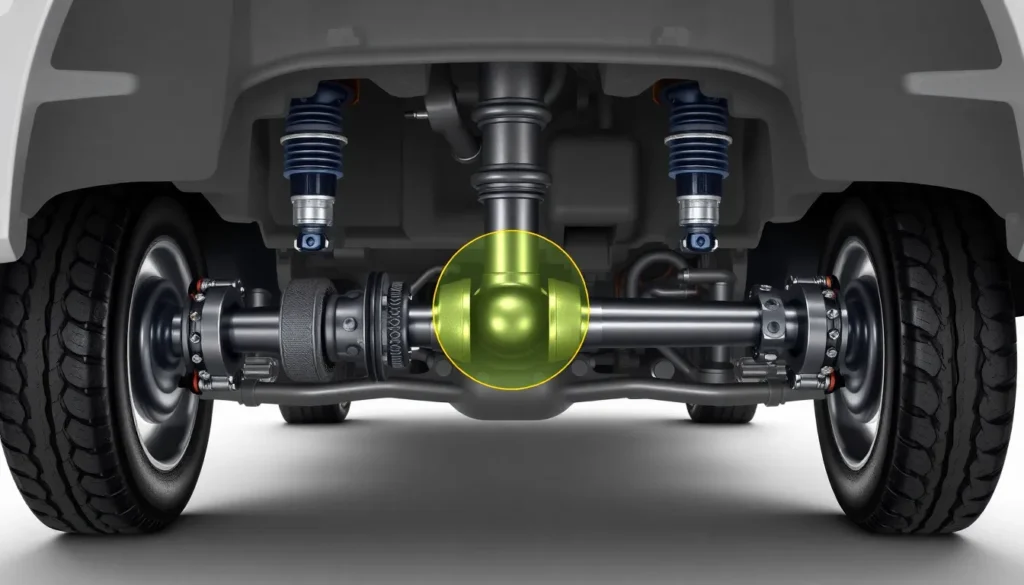
A CV joint, or constant velocity joint, is an essential mechanical component in many modern vehicles, especially those with front-wheel or all-wheel drive. It is designed to transmit power from the vehicle’s transmission to the drive wheels at a constant rotational speed, regardless of the angle between the input and output shafts. This capability allows for smooth transfer of torque while accommodating the up-and-down motion of the suspension and the side-to-side movement of steering.
Detailed Explanation
CV joints enable the drive shaft to flex in response to changes in angle while maintaining a consistent velocity of rotation. Unlike universal joints, which can cause speed fluctuations at certain angles, CV joints ensure that the output shaft spins at the same speed as the input shaft. This is particularly important in front-wheel drive vehicles, where the wheels need to both steer and move up and down with the suspension, requiring the drive shafts to operate at varying angles.
There are several types of CV joints, with the most common being the ball-type joint used on the outer end of the drive shaft and the tripod-type joint often found on the inner end. The ball-type joint allows for smooth transfer of torque while accommodating changes in steering angle. The tripod-type joint permits axial movement to compensate for suspension travel.
How It Works
A CV joint consists of an inner race, an outer race, balls or rollers, and a cage to hold the balls in place. In the ball-type CV joint, the balls are positioned between the inner and outer races and move within grooves that maintain a constant velocity relationship between the input and output shafts. As the suspension moves or the wheels turn, the joint allows the shaft to bend while transmitting torque without speed variations.
The joint is protected by a flexible rubber or plastic boot filled with grease to ensure lubrication and prevent contaminants such as dirt and water from entering. Proper lubrication is crucial for the longevity of the CV joint, and damage to the boot often leads to joint failure.
Examples
- In a front-wheel drive car, the CV joint connects the transaxle (transmission and differential combined) to the front wheels, enabling the wheels to turn left or right while being driven by the engine.
- In all-wheel drive vehicles, CV joints are used on both front and rear drive shafts to accommodate suspension and steering movement.
- Some rear-wheel drive vehicles with independent rear suspension also use CV joints to transmit power to the wheels while allowing suspension articulation.
Pros and Cons
- Pros: Ensures smooth power transmission at varying angles; reduces vibration and wear; allows for steering and suspension movement; typically durable with proper maintenance.
- Cons: Susceptible to damage if the protective boot fails; replacement can be costly; requires regular inspection and maintenance to prevent premature failure.
Comparison Table
| Aspect | CV Joint | Universal Joint (U-Joint) |
|---|---|---|
| Meaning | A joint that transmits constant rotational speed while accommodating angular changes. | A joint that allows angular movement but causes speed fluctuations at certain angles. |
| Function | Maintains constant velocity between input and output shafts. | Allows angular movement but does not maintain constant velocity. |
| Usage | Common in front-wheel and all-wheel drive vehicles. | Typically used in rear-wheel drive vehicles with solid rear axles. |
| Durability | Requires protective boot and lubrication; sensitive to contamination. | More robust but can cause vibrations at high angles. |
Decision Checklist
- Use this if you need to transfer power smoothly through varying angles, such as in front-wheel drive or all-wheel drive vehicles.
- Avoid this if the application involves large angles where universal joints may be more suitable, or if cost is a primary concern and simplicity is preferred.
- Check this first if the CV joint boots are intact and properly lubricated to ensure longevity and proper function.
What is the easiest way to understand a CV joint?
Think of a CV joint as a flexible connector that allows a spinning shaft to bend and turn while keeping the rotational speed steady. It’s like a bendy extension cord for power delivery that doesn’t let the power flicker or slow down, essential for cars where wheels both steer and move up and down over bumps.
FAQ
What does a CV joint do in a car?
A CV joint transmits power from the vehicle's transmission to the wheels at a constant rotational speed while allowing for steering and suspension movement.
How can you tell if a CV joint is failing?
Common symptoms include clicking or popping noises when turning, vibration during acceleration, and grease leaking from torn CV boots.
Can a CV joint be repaired or does it need replacement?
Typically, if the CV boot is damaged but the joint itself is undamaged, the boot can be replaced and the joint re-greased; however, if the joint is worn or damaged, replacement is necessary.



Leave a Reply